
PLANTING
& CARE
Location
One of the first things to consider is whether your tree, regardless of species, will have enough room to grow to its mature size in the location you’ve chosen.
That cute little seedling in your hand may not be a great fit close to your house or in that bare spot under the power lines along your back fence. You and your tree are both better off when it’s planted in the right location for its mature size.
Avoid planting a large tree species in a location where it will require constant pruning to keep it small. Be sure to read plant tags and discuss your planting space with nursery staff before purchasing trees. You can also find helpful information through local conservation resources and trusted gardening references.
Avoid Power Lines & Utilities
Utility companies have the right to protect transmission lines that run through or alongside your property. Typically, only certain tree species are appropriate within utility rights-of-way. These trees remain short enough at maturity to stay clear of overhead lines.
Avista provides information about trees considered compatible with power lines, as well as additional guidance through its vegetation management resources. Trees that grow into utility lines may be trimmed or removed to maintain safe clearance.
As with any project that involves digging, CALL BEFORE YOU DIG — DIAL 811 to have underground utilities located before planting. The service is free, but repairs aren't!
Also consider the future growth of the tree’s root system. Avoid planting directly over underground utilities where roots could cause problems or where future utility maintenance could require removal of the tree.
Give It Room to Grow
A large tree species planted too close to a building can cause damage to both the structure and the tree. Limbs or trunks may come into contact with siding, eaves, or roofing, and roots can sometimes interfere with foundations. If your property has a septic system, avoid planting trees near underground tanks or drain fields.
If your property is located on a street corner or includes or borders a driveway, it’s also important to maintain clear sightlines for safe driving conditions. Landscaping requirements near streets, driveways, and intersections vary by municipality. As an example, see the City of Spokane Vegetation and Traffic Safety Guidelines (PDF, 1999).
Consider the Shade
Keep in mind that evergreen trees, such as Ponderosa Pines, provide shade year-round. Avoid planting evergreens where winter ice and snow could become an issue due to reduced sunlight.
Ponderosa Pines are an approved City of Spokane street tree, but their year-round shade may not be ideal for streets in areas where snow and ice do not readily melt without direct sunlight, such as the South Hill, Five Mile, and Indian Trail. This is generally less of an issue on the Valley floor.
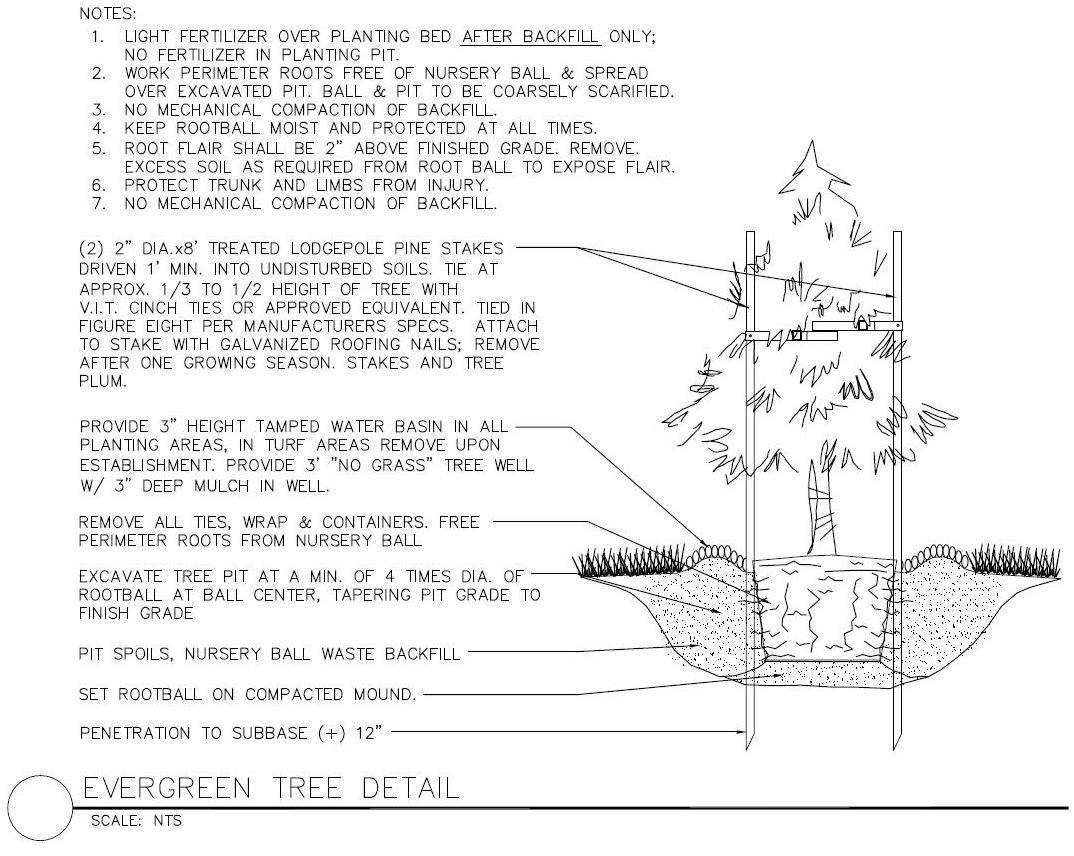
Installation Example
Here is an example of a professional planting detail for evergreen trees as seen on planting plans developed by landscape architects:
Watering
Ponderosa Pines are extremely sensitive to their root balls drying out during the establishment period. Supplemental watering is essential for Ponderosa Pines larger than seedling plug size and should continue for at least two years. Professional arborists may recommend a minimum of three years, with an additional year for every two inches of trunk caliper.
Irrigation systems with spray heads are great for shrubs and lawns, but newly planted trees requiring supplemental watering need more than spray heads typically provide. If you have newly planted Ponderosa Pines, or other large tree species, provide additional water in a way that thoroughly saturates the soil around and throughout the root ball.
Here are a few suggestions for supplemental watering:
- Install separate bubbler zones for your trees.
- Provide temporary irrigation to the trees separate from the spray zones.
- Hand watering the root ball area with a garden hose.
Proper Pruning
People typically think of deciduous trees when it comes to pruning, but Ponderosa Pines can be pruned too. As most evergreen trees mature, they lose their needles and smaller branches closest to the trunk while retaining newer green needles on their outer branches. Ponderosa Pines can be especially picturesque when dead material has been removed.
Pruning can be done yourself, but we suggest hiring a certified arborist, especially when trees are large and require climbing equipment to prune safely. If you don’t already have an arborist, we suggest contacting the Spokane County Conservation District for information about local arborists.
Best Practices
Tree Protection on Construction and Development Sites
A Best Management Practices Guidebook for the Pacific Northwest, Oregon State University Extension
Tree Owner’s Manual
U.S. Forest Service, Urban and Community Forestry
Water Requirements for a Ponderosa Pine Tree
Home Guides SFGate
Planting a Pine Tree: Caring for Pine Trees in the Landscape
Gardening Know How
Tips for Growing Ponderosa Pine
Home Guides SFGate